
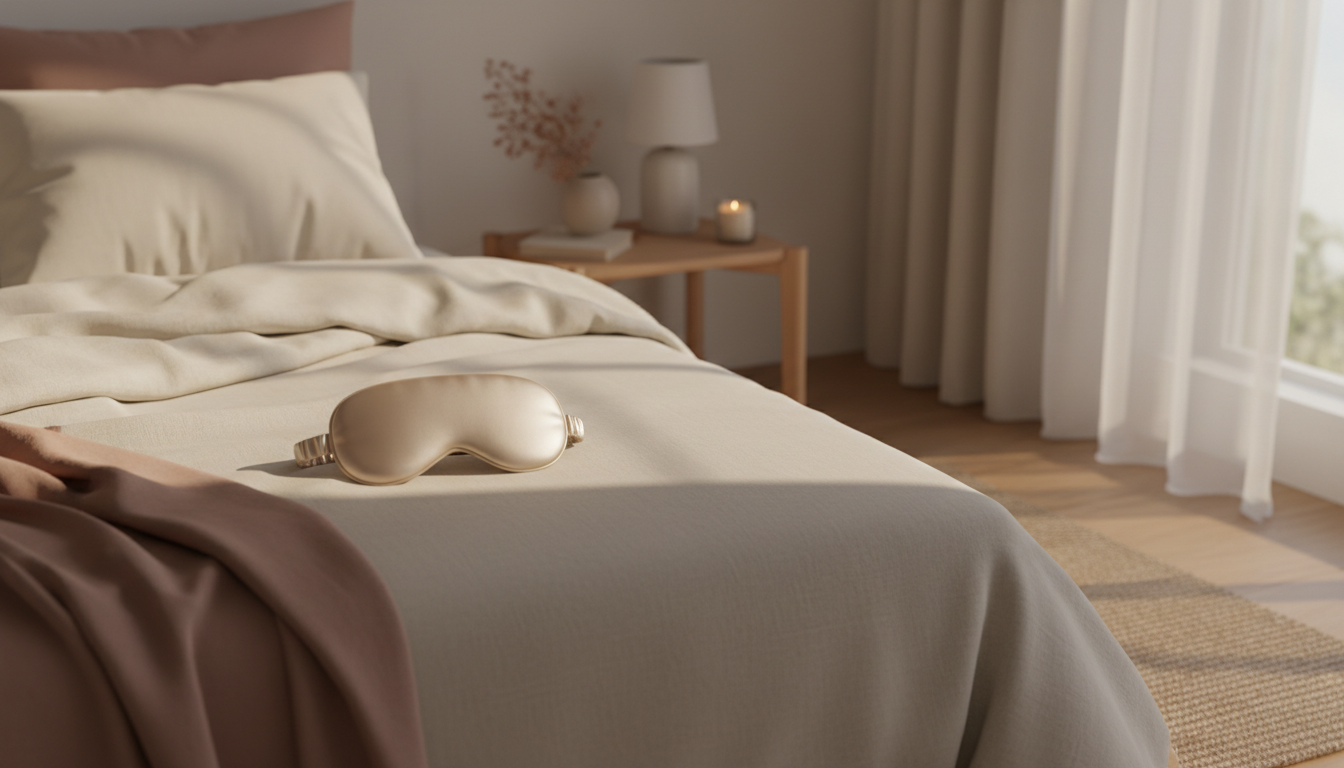
Our bodies have been tuned to the rhythm of day and night for a very long time. Light tells us when to be awake; darkness tells us it’s time to rest. Modern life, with streetlights, screens and early summer sunrises, blurs that signal.
Light, melatonin and your body clock
When it gets dark, your body releases melatonin, a hormone that helps signal that it is night. Light, especially in the evening and at night, holds it back.
A study from Harvard Medical School and Brigham and Women’s Hospital (Gooley et al., 2011) compared people in ordinary room light with people in dim light. Room light before bedtime delayed the start of melatonin release in almost all participants and shortened the time melatonin was present by about 90 minutes. Room light during the usual hours of sleep suppressed melatonin by more than half.1

What happens when you wear an eye mask?
Researchers at Cardiff University asked young adults to sleep with an eye mask for a week, and for another week with a mask that let light through (Greco et al., 2023). After the nights with the real mask, participants did better on a memory task and reacted faster on a test of alertness. They didn’t sleep longer or rate their sleep as better, so the effect seems to be on the quality of rest rather than the quantity.2
It was a small study with healthy young people, so it is a promising sign rather than the final word. But it fits with what we know about light and sleep: a darker night is a better night for your brain.

When a sleep mask makes sense
- Light summer mornings, when the sun is up long before you want to be.
- City nights, with streetlights or neighbours’ lights shining in.
- Travel: flights, trains and hotel rooms with thin curtains.
- Naps and shift work, when you need to sleep while it’s light outside.
- Sharing a bedroom with someone who reads late.
More small things for a darker night
- Dim the lights in the hour before bed, and use warm, low lamps.
- Put your phone away, or at least turn the brightness down.
- Cover small standby lights in the bedroom.
- In the morning, open the curtains: daylight helps set your body clock for the next night.
This article is general information, not medical advice. If you have ongoing trouble sleeping, talk to your doctor.
The Sương mask
Darkness, softly. Pure mulberry silk that keeps out most light without pressing on your eyes.
Sources
- Gooley JJ et al. (2011). Exposure to room light before bedtime suppresses melatonin onset and shortens melatonin duration in humans. Journal of Clinical Endocrinology & Metabolism, 96(3), E463–E472.
- Greco V et al. (2023). Wearing an eye mask during overnight sleep improves episodic learning and alertness. Sleep, 46(3).