
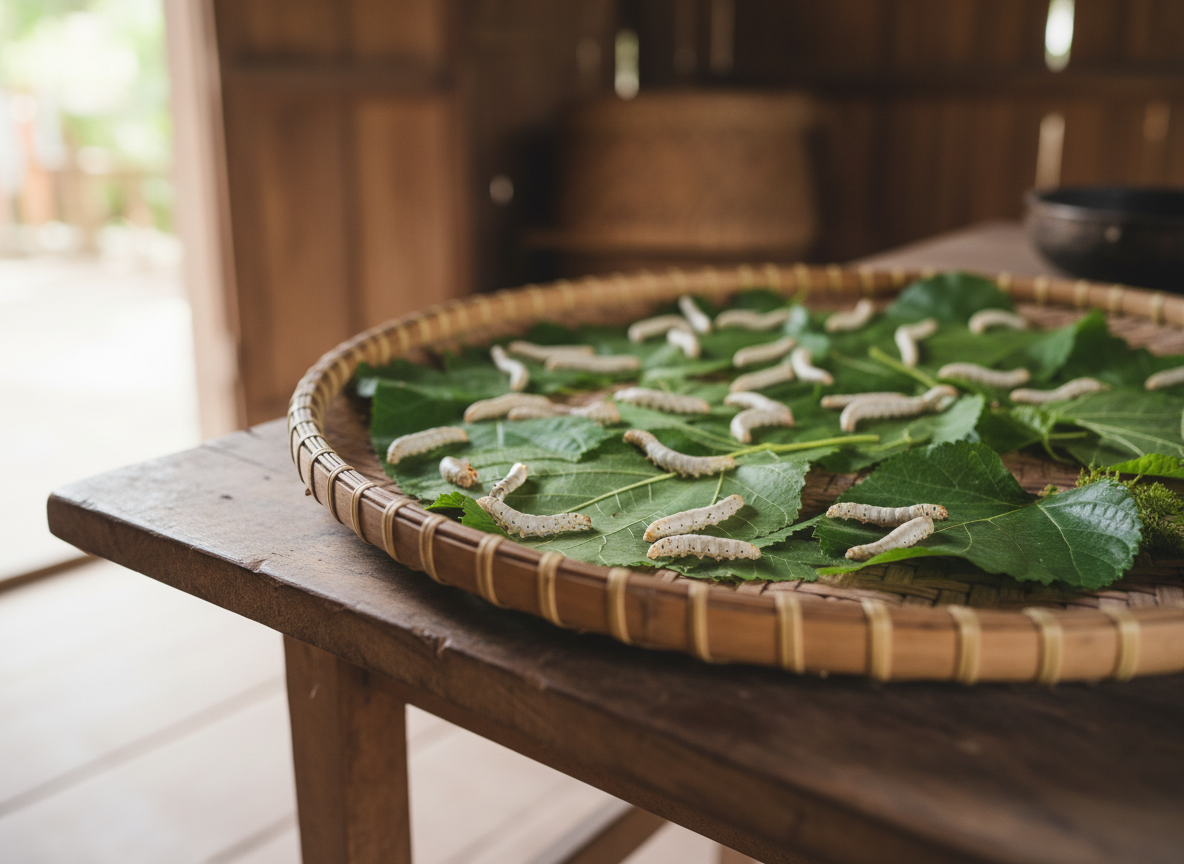
Every piece of mulberry silk starts with a small, pale caterpillar that has lived alongside people for thousands of years. This is the silkworm, from egg to cocoon.
A creature shaped by people
The silkworm, Bombyx mori, is not really a worm. It is the caterpillar of a moth. It was domesticated in China thousands of years ago from a wild relative, and it has changed so much since then that it can no longer live in the wild. The adult moths cannot fly, and the caterpillars depend on people to bring them their food.
A few weeks of eating
A silkworm hatches from an egg about the size of a pinhead. For the next three to four weeks it does little else than eat, day and night. It grows so fast that it sheds its skin four times, and by the end it is thousands of times heavier than on the day it hatched. Then it stops eating, and gets ready to spin.
Why mulberry leaves
Silkworms eat mulberry leaves and almost nothing else. The leaves give them the protein they turn into silk, and one steady diet gives a fine, even thread. That evenness is what makes mulberry silk feel so smooth. You can read more about it in What is mulberry silk?

Two or three days of spinning
When it is ready, the silkworm finds a quiet corner and starts to spin, moving its head in a figure of eight. Over two to three days it wraps itself in a cocoon made from one continuous thread, often several hundred metres long.
That thread comes out as two very fine strands of a protein called fibroin, held together by a second protein, sericin. The sericin is washed away later, when the silk is processed. What is left is the soft, gleaming fibre we know as silk.

Inside the cocoon
Inside the cocoon, the caterpillar turns into a pupa and then into a moth. If the moth is allowed to come out, it breaks through one end of the cocoon, and the long thread is cut into short pieces. To keep the thread long and unbroken, most mulberry silk is made from cocoons that are heated or steamed before the moth emerges. A share of the moths is always left to hatch, so they can lay the eggs for the next generation.
There is also so-called peace silk, made from cocoons the moths have already left. Because the thread is broken, it is spun rather than reeled, and the fabric feels softer and more matte, a little like a fine yarn.
Silkworms in Vietnam
Vietnam has raised silkworms for centuries. Today much of it happens in the highlands of Lâm Đồng, around Bảo Lộc, where the mild climate suits both the mulberry and the silkworm. Follow the whole journey, from leaf to fabric, on our Origin page.

The Sương mask
100% mulberry silk, made in Vietnam, in four colours of the early morning.