
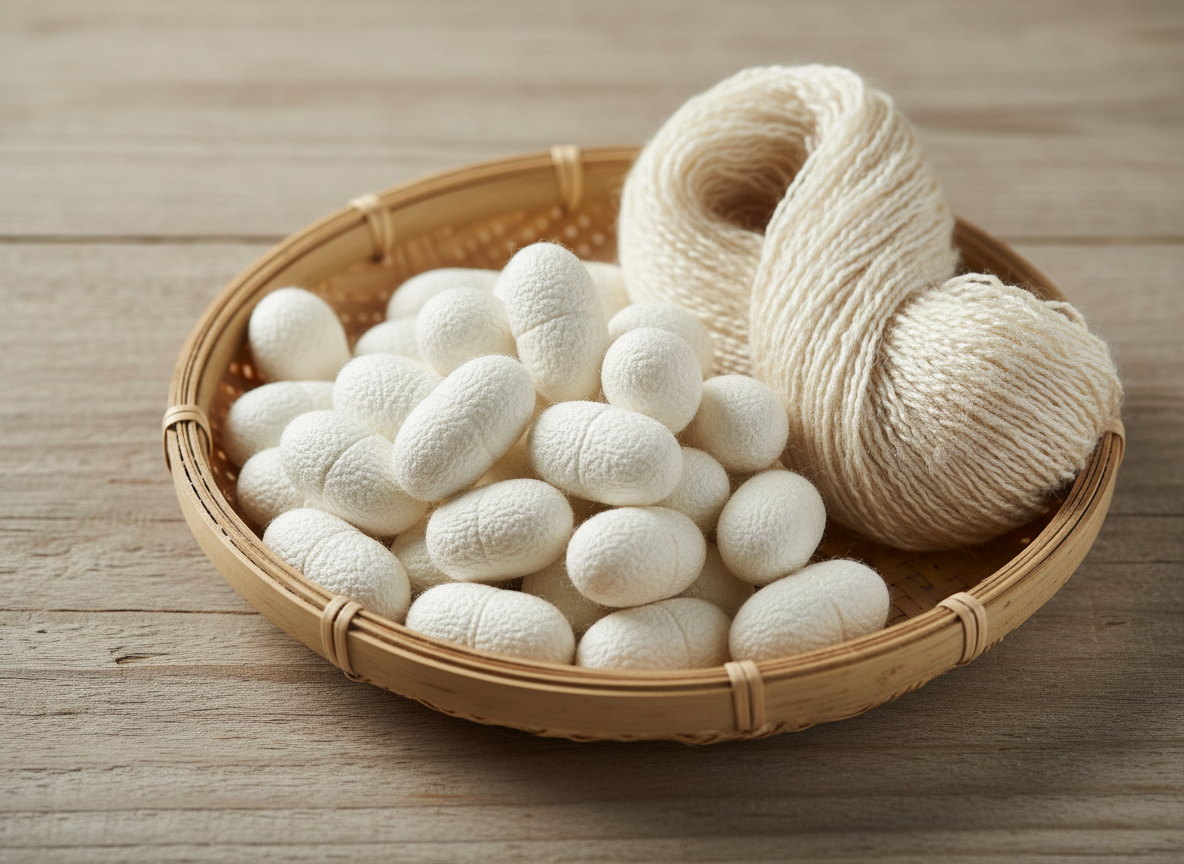
Most silk you can buy, from scarves to pillowcases, is mulberry silk. It is the smoothest and most even kind of silk there is, and it has a story that starts with a single leaf.
From leaf to thread
Mulberry silk is made by the domesticated silkworm, Bombyx mori. The caterpillars eat only the leaves of the mulberry tree. After a few weeks of eating, each one spins a cocoon from a single, unbroken thread of silk that can be hundreds of metres long.
The cocoons are softened in warm water, and the fine threads of several cocoons are reeled together into one yarn. That yarn is woven into fabric, usually as a smooth, shiny weave called charmeuse.


Because the silkworms are raised on one diet and in controlled conditions, mulberry silk fibres are long, fine and very even. That is what gives the fabric its soft sheen and its smooth, almost liquid feel. “Wild” silks, from silkworms that eat other leaves, have shorter and less even fibres and feel coarser.
What is silk made of?
Silk is a protein fibre, like wool and hair. Its core is a protein called fibroin. In the cocoon it is held together by a second protein, sericin, which is mostly washed away when the silk is processed. Being a natural fibre, silk breathes and feels cool when you first touch it.
What does “momme” mean?
Momme (say “mommy”) is the traditional unit for the weight of silk fabric. One momme is about 4.3 grams per square metre. The higher the number, the more silk is in the fabric: it feels heavier, is less see-through and lasts longer.
- Around 16 momme: light and airy, often used for scarves and linings.
- Around 19–22 momme: the most common range for sleep masks and pillowcases. Soft, with a good drape.
- 25 momme and up: heavy and luxurious, and more expensive.
How to recognise real silk
“Silky” and “satin” are not the same as silk. Many cheap sleep masks are polyester satin: shiny, but plastic. A few ways to tell the difference:
- Check the label. In the EU, textile products must state their fibre composition. Look for “100% silk” (or “100% zijde”, “100% Seide”).
- Feel it. Real silk warms up quickly in your hand and feels soft rather than slippery-cold. Its sheen is soft and changes with the light; polyester often looks glassy.
- The burn test (on a loose thread, carefully): silk smells like burnt hair and crumbles to a soft ash. Polyester melts into a hard, black bead and smells like plastic.
Silk in Vietnam
Vietnam has been making silk for many centuries, from the old weaving villages around Hanoi to the cool highlands of Lâm Đồng. Today the area around Bảo Lộc, with its mild climate and mulberry fields, is the heart of Vietnamese silk. See how mulberry silk is made, or meet the silkworm.

The Sương mask
100% mulberry silk, made in Vietnam, in four colours of the early morning.